Residential vs. datacenter proxies: choose by the job
Compare proxy origin, session needs, bandwidth costs and valid results before choosing residential or datacenter connections.

On this page Quick answer
Quick answer
Start with the simplest proxy type that meets your permitted workflow. Compare correct results, bytes and session continuity on the same workload; an IP label alone cannot predict whether a destination will accept a request.
A proxy-type decision is really a decision about a particular task: what you need to collect, which network perspective matters, and how much work you can afford to maintain. A small price-monitoring job and a localization check may both use HTTP, yet have different requirements for location and session continuity.
This guide separates the connection category from the result you need. It gives you a practical way to compare residential and datacenter routes without treating advertised pool size, a low per-GB rate or a successful status code as proof that the job is done.
How this guide was researched
A source-based decision guide, informed by saved Google/Bing topic research, DataForSEO search snapshots and common proxy-selection questions. We compare responsibilities and decision criteria, not measured provider performance.
What we evaluate- Exit origin and the network perspective the task requires.
- Correct output, repeatable location context and continuity through a unit of work.
- Complete operating cost, including unused traffic, retries and maintenance.
- Evidence boundaries: published product descriptions versus observed allocation behavior.
Quick comparison table
| Decision | Residential | Datacenter |
|---|---|---|
| Exit origin | Residential internet access | Server-hosted addresses |
| Useful starting point | Household-network perspective | Permitted checks accepting server-hosted traffic |
| Session continuity | Depends on allocation and exit availability | Depends on allocation and session terms |
| What to measure | Correct results, bytes and continuity | Correct results, bytes and continuity |
| Guaranteed destination access | No | No |
The difference starts with the exit IP
Residential proxies use addresses associated with residential internet access. Datacenter proxies use server-hosted addresses. Those categories describe the connection origin, rather than a guarantee about permission, response quality or availability.
A residential route can be useful when your research needs a household-network perspective. A datacenter route can be sufficient for permitted checks against a service you control. Neither type supplies a browser, manages cookies or parses a response for you.
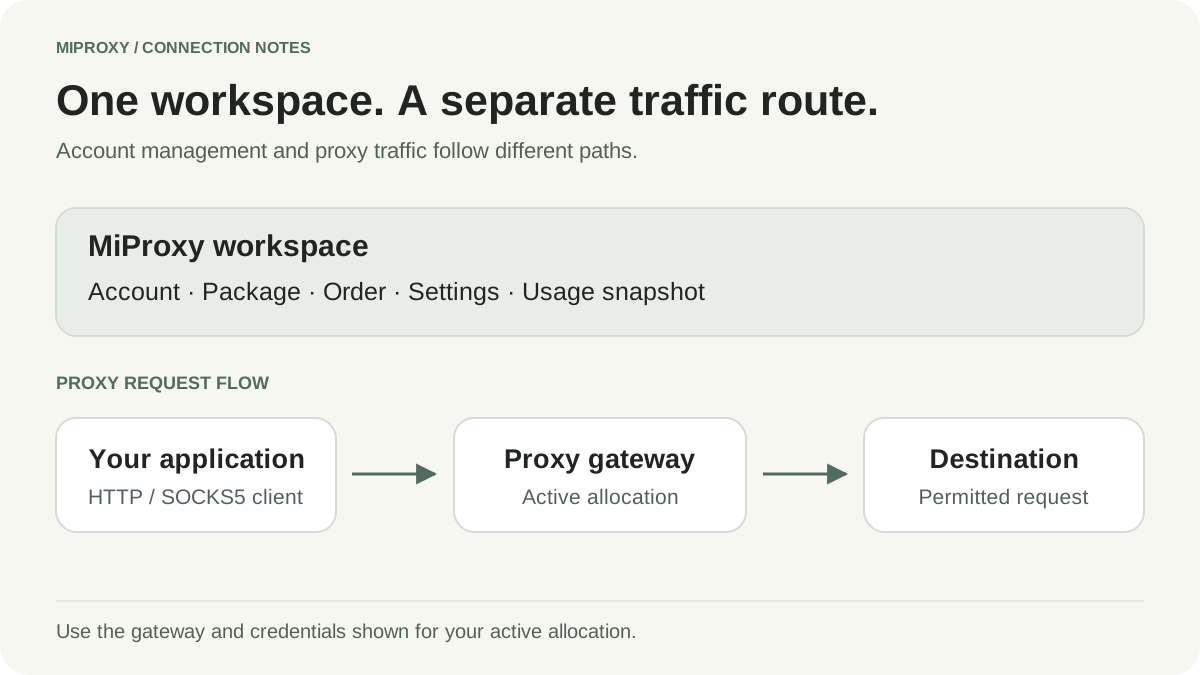
Write the requirements before choosing a pool
Define the destination, country, request rate and expected output first. A page returning HTTP 200 can still contain a consent screen or an empty result. Count a request as successful only after validating the content your workflow needs.
- Location: record requested country and observed location separately.
- Continuity: decide whether a task needs one exit throughout a session.
- Protocol: verify the exact endpoint supports your client and destination.
- Data: define required fields, freshness and duplicate handling.
Compare cost per correct result
Run the same small, authorized sample with a fixed timeout and concurrency. Record attempted requests, correct records, transferred bytes and elapsed time. Include retries and engineering time when comparing the total cost.
For illustration only, a $10 run producing 800 correct records costs $0.0125 per correct record. A cheaper $6 run producing 300 costs $0.02. These are arithmetic examples, not MiProxy benchmarks. Increase the sample only after the acceptance criteria are stable.
Write a one-paragraph decision brief
Before opening a pricing page, describe one repeatable job in ordinary language. For example: retrieve an approved public price field for a fixed list of products, from a defined country, once a day, within an agreed reporting window. State whether a missing field counts as a failure and whether a second attempt is allowed. That brief makes a later comparison interpretable.
Location is an observation, not a checkbox
A requested country tells the gateway what you asked for. An observed exit address and a destination’s response tell you what happened. Those observations can differ from the location displayed by a search engine or website. Keep the requested location, observed result and time together rather than labeling every localized response as correct.
If the task is a localization check, define the expected currency, regional content or availability rule in advance. One valid regional page is stronger evidence for that check than a generic IP-location label. It still does not establish accuracy for every city or destination.
A session requirement needs an ending
Decide whether each request stands alone or belongs to a multi-step task. A sequence that relies on cookies or an authenticated session may need a consistent route as well as consistent client state. An independent public-page request may not. Specify the task boundary instead of choosing sticky routing for everything.
Also define what happens if the route changes halfway through: restart from a safe point, preserve partial output for review, or stop. Continuing blindly can create an apparently complete dataset assembled under different assumptions.
Residential routing: useful perspective, extra questions
Residential origin can matter when the approved task calls for the perspective of a residential internet connection. That is a reason to evaluate the route, not evidence that every request will be accepted or every returned field will be correct.
When the additional route has a clear purpose
Use an explicit requirement such as comparing your own application’s regional behavior from an approved residential exit. Confirm which locations and session controls are actually supplied by the selected allocation. Treat product-wide labels and the settings visible in a dashboard as separate from the result observed by the destination.
What to resolve before relying on it
Ask how exit changes are handled, how transferred traffic is counted, what connection protocols are documented and which limits apply to your exact plan. Record the answers with the date. If those details are missing, a large advertised pool does not fill the evidence gap.
Where it helps
- Can supply the residential-network perspective required by a specific authorized task.
- Can be evaluated with location and session controls when the selected provider documents them.
What to account for
- Residential origin alone does not establish permission, accurate content or destination acceptance.
- Allocation terms, exit availability and metering still need verification for the selected workflow.
Datacenter routing: judge it against the same output
Datacenter addresses originate in server infrastructure. If that route meets a permitted task’s requirements, there is no reason in this guide to reject it solely because another product carries a residential label. Compare the output you need and the work needed to sustain it.
When server-hosted routing is sufficient
An authorized check against an application you control may require a stable, documented route without requiring a household-network perspective. In that situation, determine whether the chosen allocation supplies the continuity, protocol and concurrency you need. Those product properties do not follow automatically from the word datacenter.
When the requirement changes
If a task specifically requires residential origin, a correct response from a server-hosted address may still fail that requirement. Conversely, a block or empty page is a symptom to diagnose, not proof that all datacenter routes fail. Separate the category requirement from configuration problems and destination access rules.
Where it helps
- May satisfy tasks that accept server-hosted traffic without adding an unnecessary origin requirement.
- Can be compared using the same correct-output and operating-cost criteria as a residential allocation.
What to account for
- Does not provide a residential origin when that is an explicit requirement.
- A datacenter label does not establish static ownership, unlimited traffic or reliable access.
Make the comparison interpretable
A useful comparison changes one meaningful variable at a time. Use the same permitted destination sample, expected fields, client version, timeout policy and request schedule. If you alter the parser or increase retries for only one route, the resulting totals no longer isolate the connection decision.
Keep a small acceptance scorecard
For each attempt, record a non-secret task identifier, time, intended route, response status, whether the required fields were correct and complete, transferred bytes when available, and elapsed time. Classify failures rather than placing every unsuccessful attempt in one bucket. Authentication, DNS, TLS, destination limits and parsing problems need different remedies.
Do not publish a success percentage without its sample size, destination and counting rule. A short exploratory sample can reveal a configuration problem. It cannot establish network-wide uptime, global coverage or a provider’s long-term reliability.
Turn the scorecard into a purchasing decision
Add the actual payment, traffic consumed and work needed to collect valid output. For intermittent usage, note any balance left unused at expiry. For recurring usage, include monitoring and parser maintenance. Keep engineering assumptions explicit even if you cannot price every hour precisely.
Choose a route only after identifying which requirement it meets better and whether that improvement matters enough to justify the total cost. If both routes meet the acceptance rule, commercial terms and operational simplicity can decide the result. If neither does, revisit the data source or task design before buying a larger plan.
Four conclusions the comparison cannot support
A route comparison has limits even when the sample is carefully recorded. Keep those limits alongside the decision so that a later reader does not turn a local observation into a general product claim.
- One working request does not prove all destination types work.
- A requested location does not prove the destination interpreted it the same way.
- A sticky setting does not establish permanent ownership of an exit IP.
- A lower package payment does not establish a lower cost per correct result.
What MiProxy has verified
MiProxy brings proxy packages, connection settings and usage into one workspace. Access is currently limited to approved accounts. Check the selected product and allocation status before making requests; datacenter products are currently unavailable.
Which approach should you choose?
Choose the least complicated connection that satisfies the permitted task. Pay for residential routing when a documented requirement or a controlled comparison justifies it.
- A service you control accepts the existing route
- Keep that route while it meets the output and timing requirements; a different IP category is not an improvement by itself.
- The task requires a residential-network perspective
- Evaluate an actual residential allocation and validate observed location, output and continuity.
- You need structured search rankings
- Compare a documented SERP data product with the full work of maintaining raw collection and parsing.
Where MiProxy fits
Explore the connection workflow, available packages, and setup guides.
Frequently asked questions
Are residential proxies always better?
No. A permitted workflow that works reliably with a datacenter connection may not benefit from residential routing. Compare the actual result and total operating cost.
Does a proxy bypass every restriction?
No. Destinations can apply authentication, rate limits and other controls regardless of IP type. Use permitted access and honor those limits.
What is the main difference between residential and datacenter proxies?
The category describes the exit-address origin: residential internet access versus server-hosted infrastructure. It does not, by itself, establish the selected plan’s session terms, permission, response quality or availability.
Should I compare providers using price per GB alone?
No. Compare the payment and operating work required to obtain correct output. Include consumed traffic, permitted retries, unused allowance where relevant, parsing and maintenance. Keep the workload and counting rule consistent.
Does a residential IP guarantee the destination sees the requested city?
No such guarantee follows from the address category. Record requested targeting and the destination’s observed behavior separately, and verify the location context needed by your task.
Sources & review notes
Reviewed October 17, 2026. Technical definitions and provider statements are attributed below. Recommendations are MiProxy’s editorial analysis; current vendor terms should be checked before purchase.
MiProxy product status & evidence limits ↗Save & use this guide
The Markdown version includes the complete explanation, comparison, FAQs and source links. Read it offline or use it as reference material in your own research.
Share this article
MiProxy editorial
We write practical proxy explanations, setup guides and buying comparisons. Our product status, research method and source limitations are stated alongside the advice.
About our editorial approach ↗Related guides

Rotating vs. sticky proxies: match the session to the task
7 min read ↗
Non-expiring proxy bandwidth: what to check before buying
6 min read ↗
MiProxy vs. Decodo: a practical evaluation checklist
8 min read ↗
How to use a proxy with cURL
7 min read ↗
Use an authenticated proxy with Python Requests
7 min read ↗