Rotating vs. sticky proxies: match the session to the task
Understand rotating and sticky proxy sessions, connection reuse, failover and the checks needed for a consistent workflow.

On this page Quick answer
Quick answer
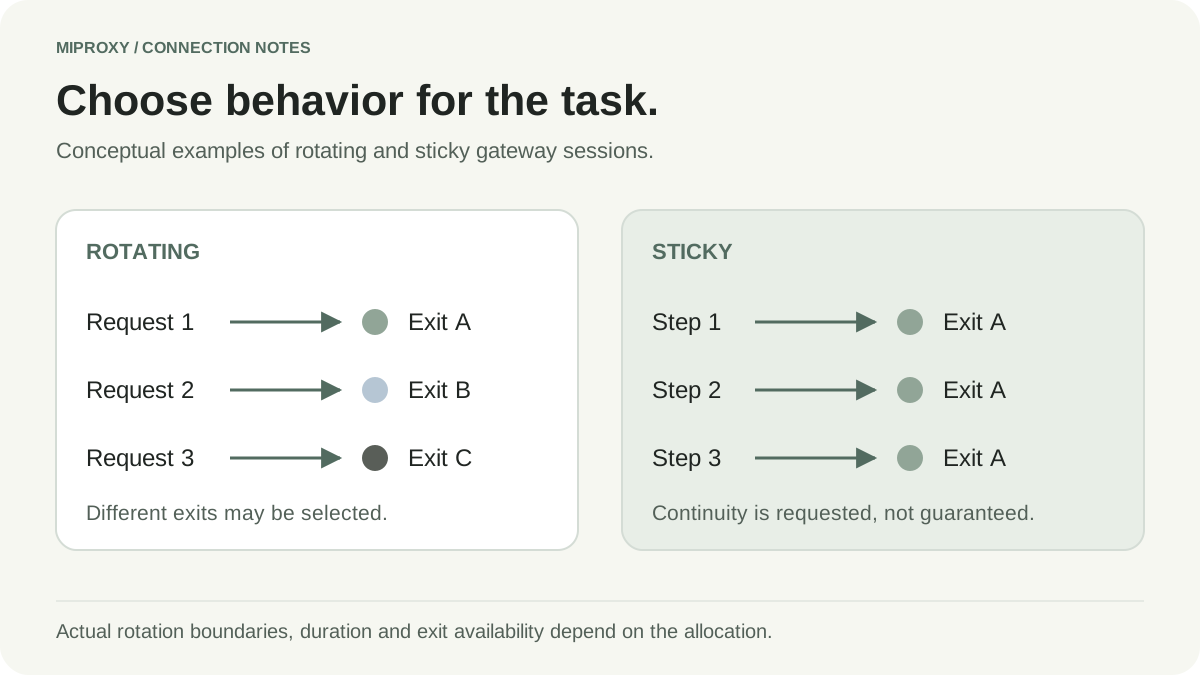
Use rotation for independent requests when changing exits is appropriate. Use a sticky session when related steps need continuity. A sticky session requests persistence; it is not ownership of a permanent IP.
The important session question is where one unit of work ends. A collection of independent checks and a sequence of related steps should not automatically use the same routing behavior. Choose the mode after describing that boundary.
This guide explains rotation, stickiness and client state separately. It focuses on what to verify in a provider’s documentation and what to record when an allocation behaves differently from the requested setting.
How this guide was researched
An explanation of session semantics using the saved rotating-versus-sticky keyword topic and provider-specific session documentation. No universal duration, pool behavior or live mode benchmark is inferred.
What we evaluate- The documented event that triggers a new exit.
- Continuity needed within a task and response to exit loss.
- Separation of provider routing from client connection reuse and cookies.
- Allocation-specific terms rather than assumptions based on product labels.
Quick comparison table
| Decision | Rotating | Sticky |
|---|---|---|
| Routing intent | Change exits at a supported boundary | Request the same exit for a period |
| Typical fit | Independent requests | Related steps needing continuity |
| Permanent IP ownership | No | No |
| Client cookies | Managed separately by your application | Managed separately by your application |
| Important check | Per-request versus per-connection behavior | Duration and response to exit loss |
Rotation and connection reuse are different controls
Providers can rotate on a new connection, a request or a configured interval. Read the plan documentation before assuming that every HTTP request gets a different exit. HTTP keep-alive and pooled connections can affect what your client observes.
Independent public-page checks can often be treated as separate units of work. Keep a bounded request rate and record the observed exit during your test. Rotation does not remove a destination’s access conditions or guarantee a successful response.
Use stickiness for a bounded workflow
A multi-step task may require a consistent exit alongside cookies and other client state. Keep the same session setting for that task and start a new one at a meaningful boundary.
A residential exit can disappear before a requested session ends. Decide what to do when that happens: restart the task, save partial progress, or stop for review. Do not silently continue an authenticated workflow from a different exit if that invalidates its assumptions.
Check the behavior instead of guessing
Test a short series against a permitted endpoint that reports the observed IP. Log timestamps and a non-secret session label. Repeat across fresh connections as well as a reused client session, then compare the results.
- Confirm whether the mode applies per connection or per request.
- Check documented maximum duration and actual observed duration.
- Separate client cookie state from provider-side session state.
- Avoid recording passwords or full credential-bearing proxy URLs.
Design the session around a real task
Write down what has to remain consistent from the first step to the last. An exit address may be one part of that state, alongside cookies, request headers and application identifiers. Changing only the proxy session setting does not update the other parts for you.
Independent checks
A permitted check of one public page can often be evaluated independently of the next. Keep each result associated with its intended location and retrieval time. If you retry a failed check with a different route, record that change rather than presenting both attempts as one observation.
Related steps
A task that first establishes client state and then retrieves a result needs a clear recovery point. Keep its route and client state aligned for the task’s duration. If a step fails, restarting the whole sequence may be more interpretable than continuing from a partially completed state.
The practical benefits and limits
Neither mode wins every workflow. The useful question is whether the documented behavior matches the unit of work you defined.
Where it helps
- Rotation can give independent work explicit route-change boundaries when supported.
- Sticky routing can request continuity across related steps.
- A deliberate session label helps group sanitized operational observations.
What to account for
- Neither setting manages browser cookies or application state.
- A requested sticky period is not a promise that an unavailable exit will persist.
- Connection reuse can make observed behavior differ from a per-request assumption.
Read an observation before changing a setting
Suppose two independent requests show the same exit. That fact alone does not prove rotation is broken: check whether the provider rotates per connection, whether the client reused a connection, and whether a different exit was promised at that boundary. Conversely, a changed exit during a sticky task needs examination even if the HTTP status remained successful.
Record only what helps diagnosis
Keep timestamps, a non-secret task/session label, the requested mode, the connection reuse pattern and the observed exit if your permitted endpoint reports it. Do not save the password or a credential-bearing proxy URL. A useful support record explains which boundary was expected to change the route.
Choose a recovery policy in advance
Define whether exit loss stops the task or triggers a fresh sequence. Keep retry counts bounded and distinguish reconnecting from changing the meaning of the measurement. A later report should show which outputs came from a restarted task rather than silently merging them.
Document the session for the next maintainer
A routing choice should survive the person who configured it. Keep the provider’s documented boundary, the client reuse behavior and the task recovery rule with the integration notes. If the client library or gateway product changes, review those assumptions together. A session suffix copied from an old example is not a durable specification.
Keep the description concrete: which steps belong to a task, which observation marks completion, and which failure requires a fresh sequence. That small handoff makes it easier to investigate a changed exit without guessing whether the behavior was expected.
MiProxy settings depend on the allocation
Use the connection controls supplied for your allocation rather than constructing an undocumented username suffix. Session duration and exit availability depend on the selected product; verify the behavior your task requires.
Which approach should you choose?
Use rotation for independent work and sticky routing for tasks that need continuity. Keep recovery rules explicit in both modes.
- Each request is independent
- Check the documented rotation boundary and verify observed behavior across the connection pattern your client actually uses.
- Several steps belong together
- Use a supported sticky setting, preserve the necessary client state and decide how the task recovers if the exit changes.
- You need a permanently assigned address
- Review a product’s explicit static-allocation terms; do not substitute a sticky-session label.
Where MiProxy fits
Explore the connection workflow, available packages, and setup guides.
Frequently asked questions
What does rotating proxies mean?
It means a proxy service changes the exit address at a supported boundary, such as a new connection or a configured interval. Check the provider’s documented behavior: rotation does not necessarily happen on every request, clear your client’s cookies, or guarantee a successful destination response.
Is a sticky proxy the same as a static IP?
No. Sticky routing requests the same exit for a period. Static products have separate allocation terms; neither should be inferred from the word sticky.
Does changing a session clear browser cookies?
No. Provider routing and browser storage are separate. Your application must manage its own cookies and task boundaries.
Does every HTTP request get a new exit IP?
Not necessarily. Providers can define rotation at a connection boundary, an interval or another documented event. Client connection reuse can affect observations, so check the selected plan and actual client pattern.
What should happen if a sticky exit becomes unavailable?
Define a recovery rule for the task: stop, restart a safe sequence or preserve partial output for review. Do not assume the requested continuity period guarantees that an unavailable exit remains usable.
Sources & review notes
Reviewed October 17, 2026. Technical definitions and provider statements are attributed below. Recommendations are MiProxy’s editorial analysis; current vendor terms should be checked before purchase.
- Oxylabs: residential proxy session control — provider-specific semantics ↗Checked 2026-10-16
- Requests: advanced usage and proxies ↗Checked 2026-10-16
Save & use this guide
The Markdown version includes the complete explanation, comparison, FAQs and source links. Read it offline or use it as reference material in your own research.
Share this article
MiProxy editorial
We write practical proxy explanations, setup guides and buying comparisons. Our product status, research method and source limitations are stated alongside the advice.
About our editorial approach ↗Related guides

Residential vs. datacenter proxies: choose by the job
9 min read ↗
Use an authenticated proxy with Python Requests
7 min read ↗
How to use a proxy with cURL
7 min read ↗
Non-expiring proxy bandwidth: what to check before buying
6 min read ↗
Fix HTTP 407 Proxy Authentication Required
7 min read ↗